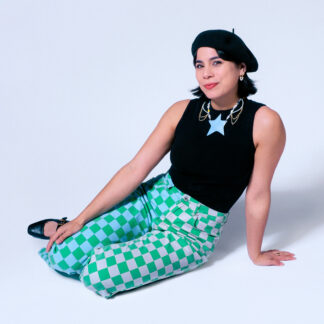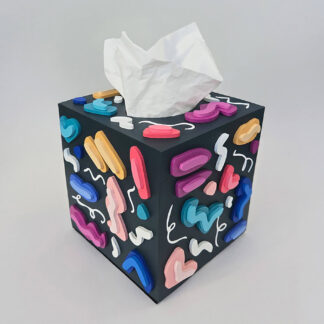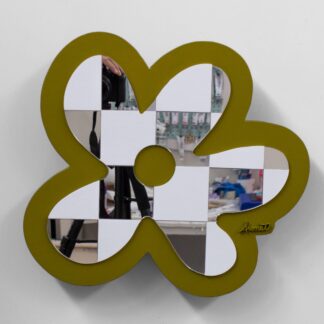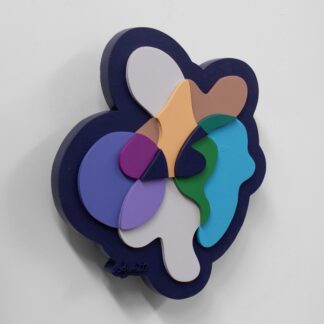

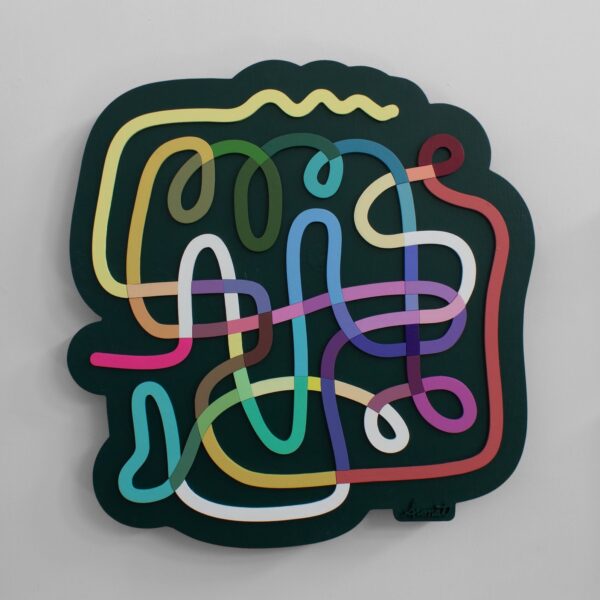
“My greatest hope is that someone stops in front of my work and simply lights up. I want that instant spark of joy, the kind that makes you forget yourself for a moment and just play,” says Katie Aronat. “I think my work speaks to the inner child in all of us. The colors, the abstract shapes, the squiggles and layers invite you to slow down and explore, to find your own meaning rather than being told what to see. There's something wonderfully freeing about that. Children feel it immediately; they want to touch it, to get lost in the depth and dimension. But I find adults often need that permission too, permission to just feel something without overthinking it.
“What excites me most is when someone says, 'It reminds me of…' and fills in the blank with something completely personal to them. That's the magic. I've created something open-ended, and it becomes a little mirror reflecting a piece of their world back to them. At its core, I just want to make people smile. If my work transports you somewhere simpler, brighter, and more playful for even a few minutes, that's everything.”
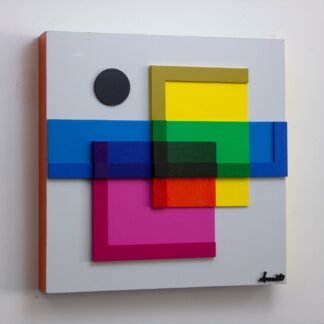
People are often surprised to learn that my favorite subject in school was Math. I was the kid taking a second Calculus class before school even started, and I went on to receive a small scholarship from the Math Honor Society. I used it to study Design and Media Arts at UCLA — which I think says everything about who I am. I have always lived in both worlds: creative and analytical. That blend showed up throughout my career too. As a designer, I was the one insisting that every layer be named and every folder be structured. Eventually I moved into Project Management, which let my creativity find a new outlet while leaning fully into my love of systems. My art is where those two halves finally meet. What looks like free, playful abstraction is actually brought to life through a very precise process: laser-cutting, painting, and assembling each piece like a puzzle. The creativity and the system depend on each other. Neither works without the other. That's really what my work reflects: the fact that I have never had to choose between being imaginative and being methodical. My art is proof that those two things don't just coexist — they make each other better.
In some ways, the process answers that question for me: the piece is finished when the puzzle is fully assembled. But knowing when something is ready to move from digital to physical, that's where intuition takes over. I can iterate endlessly on screen, and I do. But at a certain point, I feel an overwhelming curiosity to see what a design will look like with real depth and dimension. That curiosity is my signal. What happens next is always a little magical. My designs are flat and two-dimensional on a screen, so when they come to life through layers, texture, and vibrant real-world color, the piece is completely transformed. The original digital design never does it justice, and honestly, that's my favorite part. There's always a moment of surprise, even for me.
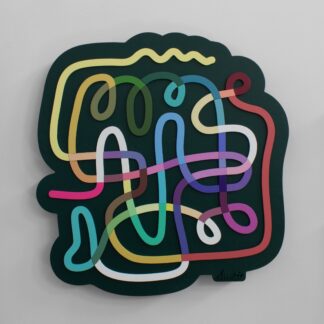
My favorite title is "Somewhere Along the Line". The piece is a single continuous line that twists and overlaps itself, changing color at every crossing. It's made up of many individual pieces, and to me, each one represents a moment in time: a day, a week, a chapter, a phase. No two human journeys look the same. We each have our own squiggly, unpredictable path, full of change and color and unexpected turns. But it's ours. And when I look at this piece, I see a life lived over time. The title carries that meaning. Somewhere along the line, things shift. Somewhere along the line, you change. Somewhere along the line, without even realizing it, you became who you are today.